Systema Munich: Natural Movement. Real Self-Defence.
Russian martial art built on four principles: breath, relaxation, awareness, calm.
No competitions, no belt exams, no fixed techniques. Instead: breath work, realistic
self-defence, and a system that adapts to you. Thursdays, small group, taught by 2
officially certified Systema Vasiliev instructors. One of five official Systema Vasiliev
schools in Germany — the only one in Southern Germany. English speakers welcome.
Systema is a traditional Russian martial art in modern form, shaped by Mikhail Ryabko
and Vladimir Vasiliev. For Christian it is the perfect application of the principles of
Inner Kung Fu: natural movement, breath control and the ability to act under pressure.
The school in its current form was opened to civilians in the 1990s by Lieutenant
Colonel Mikhail Ryabko and his senior student Vladimir Vasiliev. Vasiliev founded the
international Systema headquarters in Toronto in 1993; today more than 600 certified
instructors teach this curriculum in over 40 countries. Mikhail Ryabko passed away in
April 2023; the lineage is carried forward by Vasiliev and a close circle of directly
certified instructors. For students who want to go deeper, the book
“Let Every Breath…” — co-authored by Ryabko and Vasiliev —
documents the core breathing methods.
Since October 2025 we offer official Vasiliev Systema in Munich – with two directly
certified instructors in the lineage Ryabko → Vasiliev → Weidl. More on the
international organisation at
russianmartialart.com.
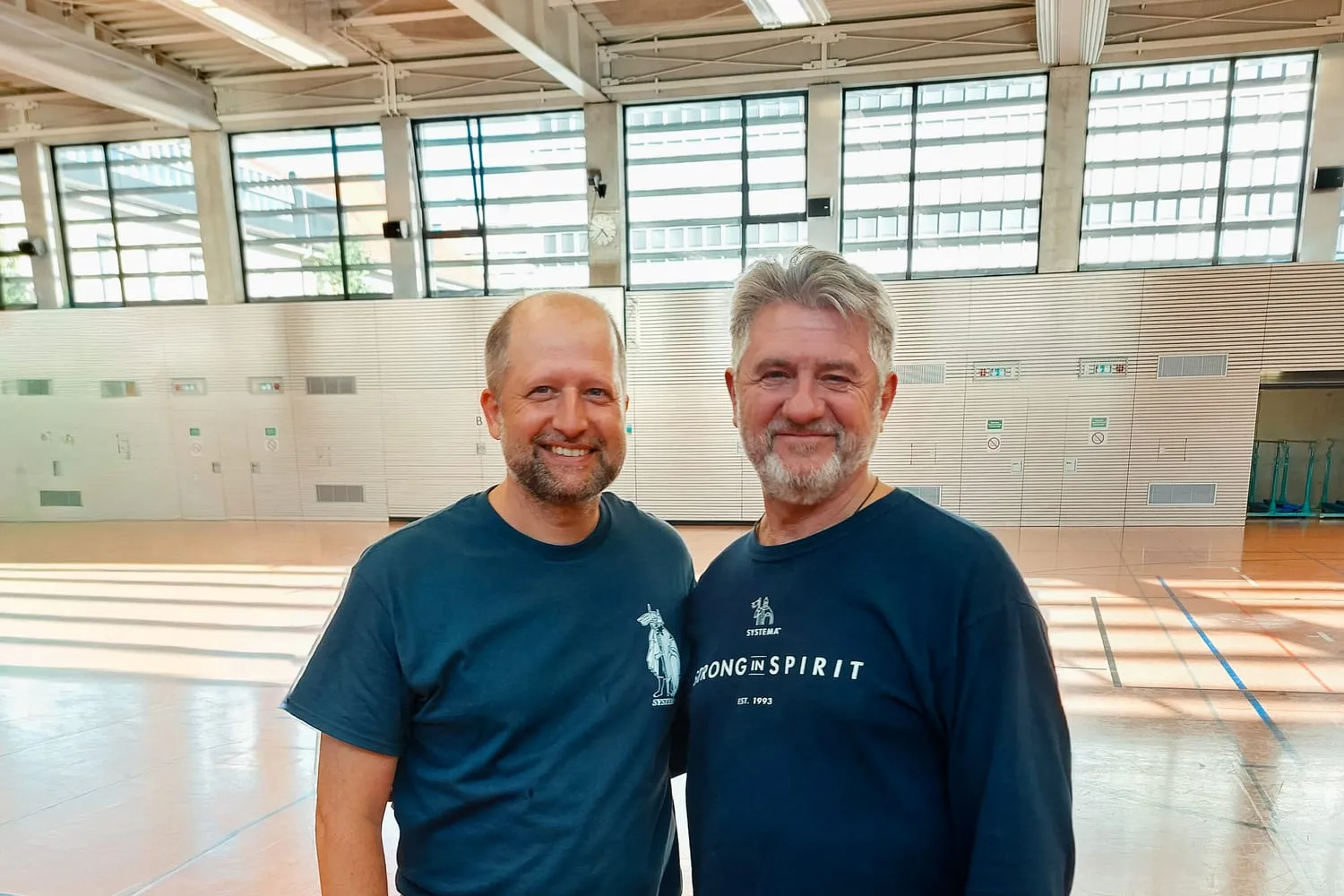
Christian with Vladimir Vasiliev — direct certification from the founder of Systema.
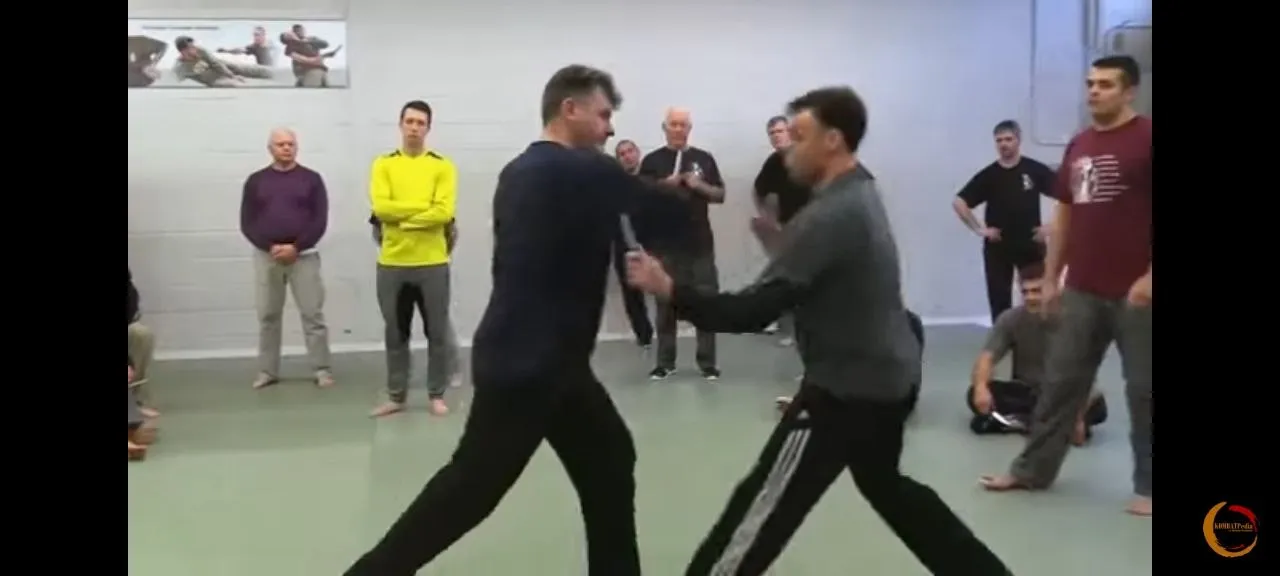
Systema group training.
Systema answers the question: how do I move naturally, breathe calmly and stay capable – even under real pressure?
The four core principles
Unlike technique-driven martial arts, Systema builds on four universal principles that
apply in any situation:
息
Breath – the foundation of everything
Breathing is the most important tool in Systema. Through conscious breath control
you learn to regulate stress, pain and exhaustion. A calm breath means a clear mind –
even when the situation is chaotic.
柔
Relaxation – no force against force
Systema does not use muscle strength but softness and natural movement. Your body
flows around resistance rather than fighting it – protecting joints and making you
more effective than any strength athlete.
覚
Awareness – an alert mind without tension
Systema trains an open, relaxed awareness. You perceive more, react faster and
make better decisions – without the mental tension that slows reactions.
静
Inner calm – strength from the centre
Perhaps the most important skill: remaining calm when others panic. In Systema
training you cultivate this calm under increasing pressure – until it becomes second nature.
What you actually learn in class
Systema has no fixed technique catalogue – but every session covers concrete skills
you work on. Here's what's on the syllabus:
Breath work & stress regulation. Several breathing patterns for different situations: hidden breathing under pressure, breath in pain, breath after exhaustion.
Natural movement & falling. Falling on any surface without impact. Not judo ukemi – flowing, deliberate lowering of the body on parquet, asphalt, stairs.
Strikes, palm strikes & takedowns. Power from relaxation, not muscle tension. Short distances, direct paths.
Groundwork. Getting up from any position, escaping pins, not becoming the target on the ground.
Weapon defence – knife, stick, improvised. Principles for armed opponents, not choreographed drills.
Multiple attackers & group pressure. Movement in space, sightlines, distance control when more than one person demands your attention.
Pain and fatigue tolerance. Not a macho ritual – targeted exercises that make you aware of your own limits.
Partner work & trust. Controlled drills with resistance that train coordination and self-awareness.
Tip: Inner Kung Fu & Wuzu Quan pairs
well with Systema – many principles overlap and reinforce each other.
Systema vs Krav Maga, BJJ & more
Which martial art fits you? Each style has a different focus. A rough orientation –
not a full comparison:
Systema
Krav Maga
BJJ
Wing Chun
Origin
Russia (military → civilian)
Israel (military)
Brazil (from jujutsu)
Southern China
Focus
Breath, natural movement, principles
Fast, direct defence
Groundwork, locks, chokes
Close range, strike chains
Competition
None
None (seminar format)
Extensive (IBJJF)
Rare
Belts/grades
None
Levels (P1–P5)
Strict (white → black)
Varies
Intensity
Flexible, adaptive
High, scenario-based
Physically demanding
Moderate
Strongest at
Stress, breath, long-term growth
Quick results
Grappling, fitness
Close combat
Rule of thumb: Krav Maga is the fast self-defence crash course, BJJ the groundwork
specialist, Wing Chun the close-range school, Systema the holistic path. For many
of our students Systema isn't a replacement for what they train – it's the
complement to it.
Who is this course for?
Experienced martial artists: You have trained other styles and seek a new perspective on movement, force and self-defence.
Complete beginners: You have no martial arts background and want to start with a realistic, joint-friendly system.
The stressed: You want a practice that helps you stay calm under pressure – in training and in everyday life.
The safety-conscious: You want to develop realistic self-defence skills without competing.
Why Systema videos can look choreographed
If you search for “Systema” on YouTube, you will inevitably find videos
where students appear to fall without being touched, or where instructors produce
“magical” effects. Skepticism is fair – and we address it openly.
The truth is more ordinary: in principles training, students work softly and
cooperatively so the nervous system can learn movement before speed and resistance
are added. What looks out of context like a “no-touch knockout” is
didactic slow motion – not a stage show. Anyone who has trained against real
resistance sees those clips with different eyes.
Systema is neither esoteric nor religious. The historical roots lie in Orthodox
Russia; modern practice is secular. There is no creed in our class, no master cult,
no mystical rituals – only biomechanics, breathing and honest partner work. If
something doesn't function, we say so. If you want to test it, we test it together.
Schedule, location & price
How a session unfolds
Every session (2 hours) begins with breathing exercises to calm the mind and prepare the
body. Flowing movement exercises, partner work and realistic scenarios follow. No rigid
warm-up routine – everything develops naturally from the principles.
When & Where?
Thursdays 7:15pm–9:15pm
Grimmstraße 1, 80336 Munich, 3rd floor · Ludwigsvorstadt
At Theresienwiese · 2 min walk from U-Bahn Poccistraße (U6)
Systema is a Russian martial art with military roots built on four core principles: breathing, natural movement, awareness and inner calm. Unlike classical combat sports, there are no fixed techniques, no forms and no competition.
The goal is not to defeat an opponent but to develop body awareness, composure under pressure and genuine capability — in self-defence as much as in everyday life.
02Is Systema a Russian combat sport?
Systema is not a combat sport — it is a martial art. The distinction matters: combat sports have rules, tournaments and winners. Systema has none of those.
Its origins lie in Russian military tradition and were developed into a civilian system by Mikhail Ryabko and Vladimir Vasiliev. Today Systema is practised worldwide — not for the ring, but for life.
03Is Systema effective?
Yes — even though it looks soft and flowing at first glance. Effectiveness comes not from libraries of techniques but from internalised principles: someone who breathes, stays relaxed and moves adaptively reacts faster and more clearly than someone recalling memorised sequences.
Systema has been and continues to be used in Russian special operations forces. In civilian training the focus is on realistic scenarios, stress regulation and natural self-defence — no show, no choreography.
04Is Systema better than Krav Maga?
That is the wrong question — both systems follow different philosophies. Krav Maga relies on simple, direct techniques that can be learned quickly. Systema works deeper: instead of memorising techniques you develop principles that function in any situation.
Who suits Systema better? People who want not just to react but to understand — who aim to build body awareness, breath control and inner strength over the long term. Systema is not an 8-week course; it is a path.
05Is the class taught in English?
Yes. Our instructors speak both German and English fluently. Most sessions run in German, but explanations, corrections and questions in English are always welcome. Our students include German speakers, long-term expats, exchange students and international professionals — nobody gets left behind. If you're unsure, just email us.
06What should I wear to the trial class?
Comfortable long sportswear — jogging trousers and a T-shirt you can move freely in. Bare feet or socks; no shoes needed. No uniform, no gi, no special gear. Bring a water bottle; otherwise, come as you are.
07Does Systema have belts, exams or competitions?
No — Systema has no belt ranks, no exams and no tournaments. Progress is measured internally: how calmly you breathe, how loose you stay under pressure, how clearly you decide. For some students that's liberating; for others it's an adjustment. If you need a visible ranking system, classical combat sports are a better fit.
08How hard is the training? Do I have to spar?
You decide how deep you go. Systema often trains deliberately slowly — your nervous system learns movement before speed or resistance are added. No competitive sparring, no weight classes, no win-at-all-costs mindset. If you want intensity, you'll find it in partner work under real pressure — always with respect, never with unnecessary injury risk.
09How long until I can defend myself?
The principles — breath, relaxation, awareness — work from the first session. You respond more calmly to stress, move less conspicuously, learn to fall without hurting yourself. For genuine self-defence integration, expect 6–12 months of regular training. No 8-week promises, but also no years of waiting for the next belt.
10Can I train Systema if I'm over 40, injured or female?
Yes — Systema is built for that. Movements are joint-friendly, breath work suits every body, and because there are no strength contests, size and gender are not disadvantages. Our students range from their early twenties to well over 60. We discuss any pre-existing conditions beforehand and adapt the training to you, not the other way around.
11Is Systema connected to Spetsnaz or the military?
The roots lie in Russian military tradition, and Systema elements are trained in some special operations units. In our class that plays no direct role — we teach no military content, wear no uniforms and keep no hierarchies. What you learn is civilian Vasiliev Systema: developed for daily life, not the battlefield.
12Do I need prior experience for Systema?
No. Systema suits everyone – from complete beginners to experienced martial artists. The principles are universally applicable and adjust to your current level. Many participants with backgrounds in other arts discover an entirely new dimension of training through Systema.
13How does Systema affect health?
Systema places special emphasis on natural movement and breath control. Training strengthens body awareness, releases tension, improves coordination and teaches you to manage stress. Many participants report deeper relaxation and greater composure in everyday life.
14What is the difference between Vasiliev Systema and other Systema styles?
There are several Systema lineages (e.g. Kadochnikov, Combat Systema). Here you train official Vasiliev Systema – the line from Mikhail Ryabko through Vladimir Vasiliev to Christian Weidl. This lineage is known for its deep integration of breath work, natural movement and realistic self-defence. Our instructors are directly certified.
15Can I combine Systema with another course?
Absolutely – and it is recommended. Systema complements Inner Kung Fu and Qi Gong ideally: breathing work and natural movement deepen your understanding of both disciplines. With a combo you only pay +€10 per extra course – so just €79 for Systema plus one other course.
16How does a Systema training session unfold?
Every session begins with breathing exercises to settle the mind and prepare the body. Flowing movement exercises, partner work and realistic scenarios follow. No rigid warm-up routine – everything develops naturally from the principles. Duration: 2 hours (7:15–9:15 pm).
What our students say
What participants say about the courses.
Genuine reviews from students who trained in person in Munich.
5.0 stars · 8 reviews
IB
Ingo Buchner
November 2025 ·
I can wholeheartedly recommend this Kung Fu and martial arts school. Christian brings not only decades of experience but also a calm and enthusiasm that is rare to find these days. He takes his time, explains techniques clearly, and caters to each student individually. The atmosphere is both motivating and respectful – you simply feel welcome, whether you're training for the first time or have been for years. Anyone who wants to experience Kung Fu and holistic martial arts will find a fantastic place here.
KA
Kai Arnold
June 2026 ·
I was accepted into the class without any prior knowledge.
At the beginning, I was shown how to avoid conflict situations through careful observation and appropriate action.
Christian places great emphasis on de-escalation.
In the first few sessions, I was taught the basics of self-defense techniques to effectively protect myself from physical attacks.
I especially appreciated that Christian adapted the pace of his instruction to my comprehension and learning ability.
Since I am unfortunately confronted with physically intimidating behavior at work on a regular basis, I was able to clearly see my own progress in conflict situations.
I reacted to these situations, which I found threatening, with more composure and self-confidence.
I was surprised myself at how much my sense of security grew after just a few practice sessions.
I highly recommend Christian's classes for protecting your physical boundaries.
MN
Möchte Nicht
March 2026 ·
A highly recommended school for martial arts and Qi Gong, even though it's quite new. The classes are taught by a very experienced instructor who brings around four decades of experience and enthusiasm to various martial arts and techniques, which is clearly reflected in the training. His holistic approach is evident in his outlook on life and his attitude towards "fighting" in general. At the same time, the training is also playful and relaxed. Overall, an excellent place for anyone who wants to gain something both technically and personally.
AK
Andreas Kutschera
November 2025 ·
Toller Qi Gong Unterricht!
Lehrer mit viel Erfahrung, kann man nur Empfehlen!
Ich hab schon vor 25 Jahren bei ihm trainiert, jetzt ist er nochmal weicher, flüssiger, präziser, kraftvoller.
FD
Franz Deffner
November 2025 ·
A highly experienced instructor with extensive knowledge of all martial arts styles.
Excellent training in a relaxed atmosphere.